

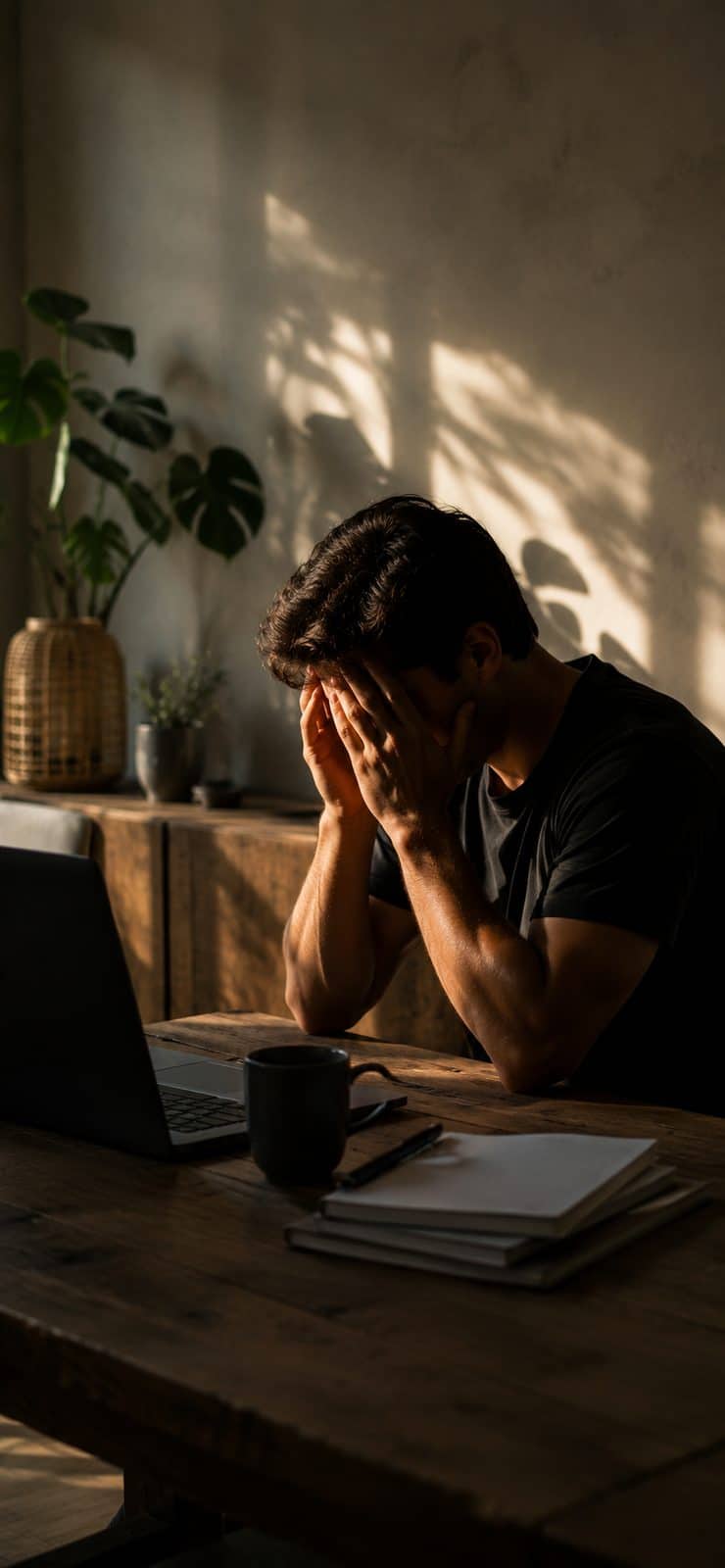
What a stress response is, what happens when it stops switching off, what the research measured it doing to a heart, and what actually lowers it.
Kratos Natural · Domain: Stress
1. What is stress?
Stress is not a mood. It is your body moving into a different mode.
Your body runs in two of them. In the alert mode your heart beats faster, your breathing gets shallow, your muscles tighten, your attention narrows and your liver puts sugar into your blood so your muscles can use it immediately. In the recovery mode your body does the opposite work: it digests your food, repairs tissue and sleeps.
Two hormones drive the alert mode, and they work at different speeds. Adrenaline arrives within seconds and clears within half an hour. Cortisol takes longer to build and stays in your blood for hours.
That is a stress response. It is not a fault, it is what carries you through a hard hour, and it is meant to end.
Chronic stress is that same response failing to end. Cortisol keeps circulating after the problem is over, and your body never fully returns to recovery mode. The first thing you lose is not the ability to react. It is the ability to come back down.
2. What does stress do to your body?
Staying in the alert mode has a physical cost, and that cost has been measured.
Your vessels, your blood sugar and your immune system. Two reviews in Nature Reviews Cardiology set out the routes: a nervous system knocked out of balance, blood sugar sitting higher than it needs to, a low level of inflammation that does not settle, and the behaviour that travels with stress, meaning worse sleep, more drinking and less movement[1][2].
The clearest number comes from work. Researchers pooled the records of 197,473 people and looked at job strain, meaning a lot being asked of you combined with very little say over how or when. That combination went with about 23 percent more heart disease[3].
Twenty-three percent is a real increase, and it is smaller than the increase from smoking. Both of those matter: stress is not harmless, and it is also not the reason behind everything that goes wrong in a body.
3. What does less stress do for you?
The other side has been measured as well, and the largest effect anyone has found is not a technique.
Other people. An analysis of 148 studies covering more than 300,000 people found that those with stronger social ties were 50 percent more likely to survive the follow-up period. The authors put that effect alongside quitting smoking, and above obesity and physical inactivity[4].
Those people were followed rather than randomly assigned, so you can argue about the direction: healthy people also find it easier to keep friendships going. It is still the largest effect measured in this field, and the only one with nothing to sell behind it.
Recovery matters more than fewer demands. You are not going to halve what life asks of you, which is why "less stress" is a poor goal. What changes your body is how often you return to the recovery mode and how completely, and that is what everything in the next chapter is aimed at.
4. What works, according to the research?
Exercise has the strongest evidence. A review of 97 earlier reviews, covering more than a thousand studies, found that physical activity clearly reduced low mood, anxiety and tension in very different groups of people, and that higher intensity worked better[5].
Slow breathing has a smaller effect. Across the trials, breathing slowly while watching your own heart rate lowered the stress and anxiety people reported[6]. Five minutes a day is a tested dose, and the patterns are in the breathwork guide.
Meditation works, and not measurably better than a walk. A review of 47 trials in JAMA Internal Medicine found moderate evidence that mindfulness improves anxiety, low mood and pain, and little evidence that it beats exercise or medication[7].
Having a say at work. The damaging part of job strain is not how much is asked of you, it is having no control over it[3]. That part can sometimes be negotiated, and it is the only item on this page that needs somebody else to agree.
5. The plan
Five steps, in the order the evidence puts them. None of it costs anything.
- See people, weekly, in person. Not in a group chat. One fixed appointment a week is enough to make it a habit: a walk, a coffee, training together. This is the largest effect in the guide[4].
- Move, most days. Anything, and preferably something that warms you up rather than a stroll. Twenty to thirty minutes is enough[5].
- Breathe slowly for five minutes, at a fixed time. Six breaths a minute, so four counts in and six counts out. Attach it to something you already do every day, like making coffee.
- Sleep on a schedule. Short sleep raises your cortisol at the end of the day, so a bad week of sleep creates the exact state you are trying to get out of. The sleep guide covers how.
- Change one thing about what is asked of you. One fixed day without meetings, or control over when something is finished[3].
6. What to leave alone
Alcohol to wind down. It works for the evening and ruins the second half of your night, and a bad night raises your stress response the next day.
Letting your heart rate variability decide how your day goes. That number in your app moves with your sleep, a glass of wine, a cold coming on, your posture and the time of day. Read over weeks it tells you something. Read every morning it is one more thing to worry about.
Waiting for a calmer period. Recovery has to fit inside a busy week rather than come after it.
7. What we honestly do not know
Whether lowering your stress lowers your heart risk. The link itself is solid. The trial that assigns people to less stress and follows them for years has never been done[1][3].
Which way the social finding runs. Illness isolates people, and isolation may in turn make people ill[4].
8. When is it not stress?
See a doctor today if:
- You are thinking about harming yourself
- You cannot work, eat or sleep any more
- You are having panic attacks
Make an appointment if:
- Low mood or rumination lasts more than two weeks and most days
- You use alcohol or something else to get through the evening
- You are putting physical symptoms such as chest pain, palpitations or weight loss down to stress. That is a diagnosis, and it is not yours to make
9. Sources
- Steptoe A, Kivimäki M. Stress and cardiovascular disease. Nature Reviews Cardiology, 2012. PMID 22473079
- Kivimäki M, Steptoe A. Effects of stress on the development and progression of cardiovascular disease. Nature Reviews Cardiology, 2018. PMID 29213140
- Kivimäki M, Nyberg ST, Batty GD, et al. Job strain as a risk factor for coronary heart disease: a collaborative meta-analysis of individual participant data. Lancet, 2012. PMID 22981903
- Holt-Lunstad J, Smith TB, Layton JB. Social relationships and mortality risk: a meta-analytic review. PLOS Medicine, 2010. PMID 20668659
- Singh B, Olds T, Curtis R, et al. Effectiveness of physical activity interventions for improving depression, anxiety and distress: an overview of systematic reviews. British Journal of Sports Medicine, 2023. PMID 36796860
- Goessl VC, Curtiss JE, Hofmann SG. The effect of heart rate variability biofeedback training on stress and anxiety: a meta-analysis. Psychological Medicine, 2017. PMID 28478782
- Goyal M, Singh S, Sibinga EMS, et al. Meditation programs for psychological stress and well-being: a systematic review and meta-analysis. JAMA Internal Medicine, 2014. PMID 24395196
More free knowledge at kratosnatural.com.
© Kratos Natural. This guide is free: read it, keep it, print it, give it to whoever you like. What you may not do: sell it or present it as your own work. The knowledge belongs to everyone. The text stays ours.