

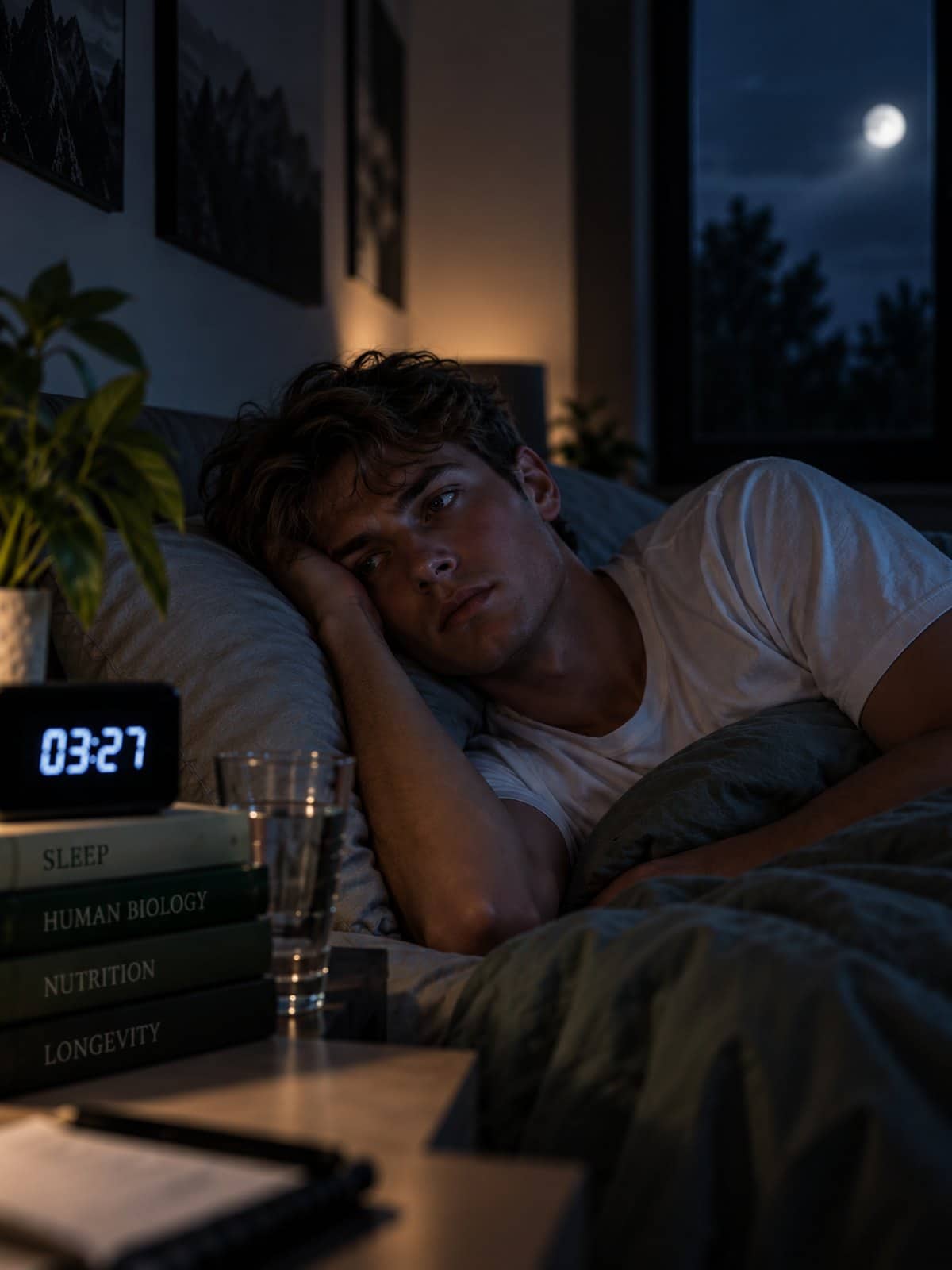
PROTOCOL 002. For anybody who wakes in the night and cannot drop off again.
Kratos Natural · Domain: Sleep
The short answer: what do you do tonight?
Do not lie there waiting: get up, do something dull in low light, and go back once you feel sleepy. Take the alcohol out of your evening as well, and drink less in the hours before bed.
| Protocol 002 | Lying awake at night |
|---|---|
| Objective | You wake and drop off again, instead of staying awake. |
| Foundation | Out of bed when you stay awake. No alcohol in the evening. Less to drink before bed. Cool and quiet. Worrying moved into the day. |
| Evidence | Strong for getting out of bed and for alcohol. Moderate for temperature, noise and worry. For the bladder it comes from a review for family doctors. |
| Watch | How long you stay awake rather than how often you wake, and how your mornings were. |
Note the difference with Not falling asleep. This is a different cause and so a different road, however alike the evenings look.
What is lying awake, exactly?
That you wake in the middle of the night and do not drop off again. You lie there, the hour passes, and sleep does not come back. That is what this protocol is for.
The waking itself is not where it gets stuck. Every night runs in blocks of about ninety minutes, and at the end of each block your sleep is light. That happens to everybody; what happens in that light moment decides whether you drop off or stay awake. The five causes below are all about that moment.
That it grows with the years does not mean you have to leave it. In a meta-analysis of 65 studies covering 3,577 healthy people aged 5 to 102, the time spent awake during the night rose with age[1]. That is what happens on average, not what you have to accept.
What it is not
Not a matter of grit. Alcohol, your bladder, warmth, noise and your thoughts turning over all sit outside you, and that is exactly why you can do something about them.
How does it work, staying asleep?
Staying asleep is not one long act but a run of blocks stuck end to end. Each block finishes in light sleep, and that is where something can tip you out.
Noise tips you out without you remembering. At low levels already it causes brief awakenings, whether it is traffic, a neighbour or a church bell, and even when you recall nothing of it the next morning[8].
Warmth keeps you in light sleep. In a study where a suit raised skin temperature by 0.4 degrees without changing the core, waking went down and sleep moved into deeper stages. In older people the chance of waking too early fell from 58 to 4 in a hundred[4].
And alcohol breaks the second half. From about two drinks it costs you REM sleep, and the more you drink the more it takes. Falling asleep faster only starts at around five, which is exactly where the rest of the night is worst hit[3].
What does the research say, per cause?
Each cause below carries how strong the evidence is, and in the same sentence why.
Getting out of bed when you stay awake. Strong. This is called stimulus control, and in an analysis weighing the parts of insomnia therapy separately it was one of the parts that worked[2].
Taking the alcohol out. Strong. It comes from a meta-analysis of trials in healthy adults, where the effect grew with the amount drunk[3].
Sleeping cool. Moderate. The evidence under it is strong but narrow: one measured trial with a suit that warmed the skin, and not a trial with a thermostat in an ordinary bedroom[4].
Sleeping quiet. Moderate. That noise causes awakenings is well measured. What earplugs and an eye mask do at home is not: that evidence comes from a meta-analysis in 1,701 patients after heart surgery, where they were part of a whole package[8][9].
The worrying. Moderate. Across eight studies following 3,733 people over time, part of the link between stress and disturbed sleep ran through the going over it, and that held once sleep at the start was counted in[5].
What helps against it is better studied than the link itself. Across fifteen randomised trials, insomnia therapy brought worry down clearly while ruminating barely moved[6].
The bladder. From a review, not a trial. Waking to pass urine is called nocturia, and in a review for family doctors the first step is not a drug but the evening itself: drink less in the hours before bed, and look at what time of day a water tablet is taken[7].
Caffeine. Strong, but it matters less here. In a randomised trial 400 milligrams still disturbed sleep taken six hours before bed, and that touches falling asleep and staying asleep together[10].
Why does it matter?
Because lying awake feeds itself. You wake, you start counting the hours you have left, and that counting is precisely what keeps you up.
That is why getting out of bed sits at the top and not at the bottom. It breaks the link between your bed and the waiting, and that link is the one part of this you can take on tonight.
The European guideline for insomnia puts therapy with behaviour and thoughts first for everybody, because its effect holds after the treatment stops[11]. Here a guideline is a subject and not an authority: it was written for doctors with a patient in front of them.
The plan
One cause a week, in this order. That is our arrangement and not a result from research.
Week 1. What you do when you are awake
If you wake and drop off again within a few minutes, do nothing. That is a night working as it should.
If you stay awake, get up. Do something dull in low light and go back once you feel sleepy. Do not look at the clock, because that starts exactly the counting that keeps you up.
Week 2. The evening: alcohol and drinking
If you drink alcohol, drink it early and not to get to sleep. It is the thing that seems to work in the short run and wrecks your second half at the same time.
If you wake to pass urine, drink less in the last two hours before bed. If you take a water tablet, ask your doctor or pharmacist what time of day to take it. Never move a medicine yourself.
Week 3. The room: cool, dark, quiet
Bedroom cool, duvet warm, feet warm. Blackout or an eye mask, and earplugs if you have street noise.
This is the week with the least work and the most patience. The effect sits in awakenings you do not remember, so you notice it in your morning and not in the night itself.
Week 4. The worrying
Write down for ten minutes during the day what is on your mind, at a fixed time, so it does not have to happen in bed. That is the habit closest to what insomnia therapy does.
If that does nothing, the next step is that therapy itself and not a remedy off a shelf. Your doctor can refer you.
What to watch
Not how often you wake, because that belongs to a night. Look at how long you stay awake, and above all at how your mornings are.
When should you see a doctor?
If you snore and others see you stop breathing. Then this may be sleep apnoea, and that is the main reason to leave this protocol alone. In a population study measured at home in 2,121 people, 49.7% of the men and 23.4% of the women had fifteen or more breathing pauses an hour[12].
The authors note themselves that those high figures partly come from equipment having grown more sensitive. So that many people are not ill: what counts is whether you have complaints with it.
If you pass urine more than twice a night. Then it starts with a bladder diary and with your doctor, and not with drinking less alone.
If you are low or anxious. Then your sleep belongs with that whole picture rather than on its own. That is a conversation and not a plan.
The background to all of it, with 120 sources, is in the sleep guide.
Sources
- Ohayon MM, Carskadon MA, Guilleminault C, et al. Meta-analysis of quantitative sleep parameters from childhood to old age in healthy individuals: developing normative sleep values across the human lifespan. Sleep, 2004. PMID 15586779
- Furukawa Y, Sakata M, Yamamoto R, et al. Components and Delivery Formats of Cognitive Behavioral Therapy for Chronic Insomnia in Adults: A Systematic Review and Component Network Meta-Analysis. JAMA Psychiatry, 2024. PMID 38231522
- Gardiner C, Weakley J, Burke LM, et al. The effect of alcohol on subsequent sleep in healthy adults: A systematic review and meta-analysis. Sleep Med Rev, 2024. PMID 39631226
- Raymann RJ, Swaab DF, Van Someren EJ. Skin deep: enhanced sleep depth by cutaneous temperature manipulation. Brain, 2008. PMID 18192289
- Zagaria A, Ottaviani C, Lombardo C, et al. Perseverative Cognition as a Mediator Between Perceived Stress and Sleep Disturbance: A Structural Equation Modeling Meta-analysis (meta-SEM). Ann Behav Med, 2023. PMID 36409327
- Ballesio A, Bacaro V, Vacca M, et al. Does cognitive behaviour therapy for insomnia reduce repetitive negative thinking and sleep-related worry beliefs? A systematic review and meta-analysis. Sleep Med Rev, 2021. PMID 32992228
- Getaneh FW, Sussman RD, Iglesia CB. Nocturia: Evaluation and Management. Am Fam Physician, 2025. PMID 40531150
- Hume KI, Brink M, Basner M. Effects of environmental noise on sleep. Noise Health, 2012. PMID 23257581
- Soh PQP, Wong WHT, Roy T, et al. Effectiveness of non-pharmacological interventions in improving sleep quality after cardiac surgery: A systematic review and meta-analysis. J Clin Nurs, 2024. PMID 38477050
- Drake C, Roehrs T, Shambroom J, et al. Caffeine effects on sleep taken 0, 3, or 6 hours before going to bed. J Clin Sleep Med, 2013. PMID 24235903
- Riemann D, Baglioni C, Bassetti C, et al. European guideline for the diagnosis and treatment of insomnia. J Sleep Res, 2017. PMID 28875581
- Heinzer R, Vat S, Marques-Vidal P, et al. Prevalence of sleep-disordered breathing in the general population: the HypnoLaus study. Lancet Respir Med, 2015. PMID 25682233
More free knowledge at kratosnatural.com.
© Kratos Natural. This protocol is free: read it, keep it, print it, give it to whoever you like. What you may not do: sell it or present it as your own work. The knowledge belongs to everybody. The text stays ours.