

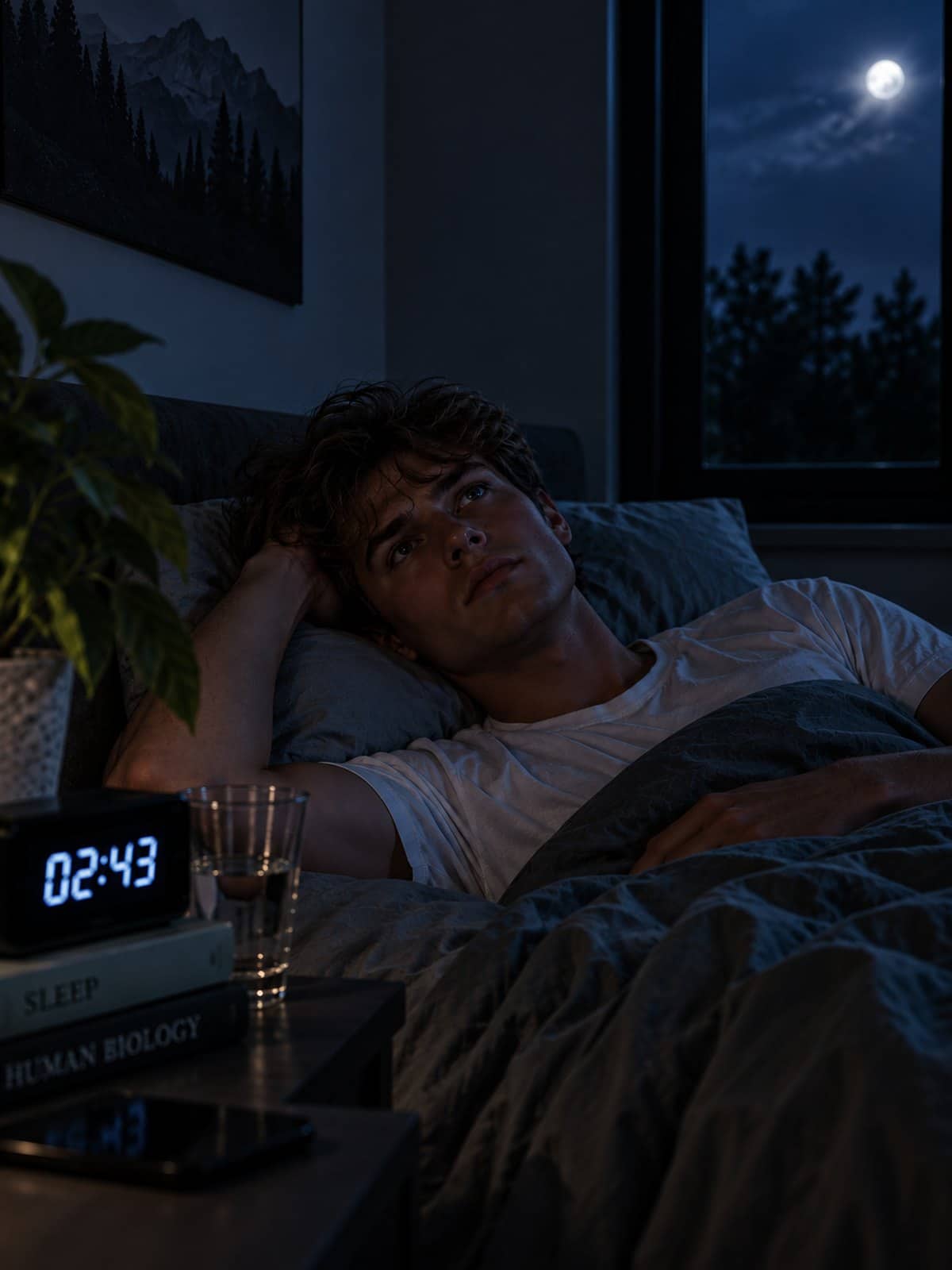
PROTOCOL 001. For anybody who cannot fall asleep at night.
Kratos Natural · Domain: Sleep
The short answer: what do you change tonight?
Get up at your fixed time tomorrow, get outside within the hour, put your last coffee six hours before bed, and make the room cool and your feet warm. If you are lying there waiting, get out of bed.
| Protocol 001 | Not falling asleep |
|---|---|
| Objective | You fall asleep instead of waiting for it, and your day runs on your own energy again. |
| Foundation | A fixed wake time. Morning light and a dark evening. A caffeine cut-off. Cool room, warm feet. No alcohol as a sleeping aid. Out of bed when you are waiting. |
| Evidence | Strong for light, caffeine, temperature, alcohol and getting out of bed. Moderate for the fixed wake time, because that one comes from a cohort. |
| Watch | How your mornings went, how many nights a week you lay waiting, and whether you still fade during the day. |
That order is not arbitrary. The top of the list returns the most, and anybody who changes everything at once will not know a month later what worked.
What is the problem, exactly?
That you do not fall asleep when you want to. You are tired, you go to bed, and sleep does not come. That is all it is, and that is what this protocol is for.
It does not have to happen every night and there does not have to be a diagnosis under it. If it happens more often than you want it to, that is reason enough to do something. Being kept awake by it is the reason to start, not a number.
So we deliberately put no minute count on it. Half an hour is ordinary for one person and a whole evening for the next. Watching the clock also keeps you awake by itself, and a protocol that has you counting the hours you have left works against itself.
What it is not
Not a matter of grit. Light, time, temperature and what is in your blood all sit outside you, and that is exactly why you can do something about them. It is also why wanting to sleep does not work: you do not fall asleep by trying harder, you fall asleep when the conditions are right.
How does it work, falling asleep?
Two things have to line up: the pressure to sleep has to be high enough, and your clock has to agree that it is night. With one of the two in the wrong place, you lie awake while tired.
The clock runs on light. Bright light early in the morning moves your clock forward and bright light late in the evening pushes it back, and that effect has been mapped hour by hour in people[2].
Ordinary room light is enough to do it. In people who spent the evening under room light, the release of melatonin, the hormone that announces night, started later and lasted a shorter time than in people sitting in dim light[3].
How much a lamp reaches your clock depends on how bright it is and how late you have it on. Eighteen chronobiologists drew up recommendations for exactly that, in a unit that measures how much a lamp reaches your clock rather than how bright it looks[4].
And your core has to cool. To fall asleep your core temperature has to drop, and your body does that by sending blood to your hands and feet. Your skin gets warmer while your inside gets colder.
How small that shift can be showed in a study where people wore a suit that raised skin temperature by 0.4 degrees without changing the core. That little suppressed waking and moved sleep into deeper stages[6].
What does the research say, step by step?
Each step below carries how strong the evidence is, and in the same sentence why. A randomised trial weighs more than a cohort, and a cohort more than one small study.
Morning light and a dark evening. Strong. It comes from measured trials in people, where light at a known hour moved the clock by a measurable amount[2][3].
The caffeine cut-off. Strong. In a randomised trial, 400 milligrams of caffeine, roughly four cups of coffee, still disturbed sleep when it was taken six hours before bed, and the people in it noticed nothing themselves[5].
Those six hours were measured. The eight we keep to when in doubt were not, and they are there because people differ a great deal in how fast they clear caffeine. That is our judgement and not a finding.
Cool room, warm feet. Strong. In a meta-analysis of thirteen studies, a bath or shower of 40 to 42.5 degrees, one to two hours before bed and ten minutes long, shortened the time it took to fall asleep[7].
No alcohol as a sleeping aid. Strong. A meta-analysis found that from about two drinks it costs you REM sleep, and that falling asleep faster only starts at around five, which is exactly where the rest of the night is worst hit[8].
Out of bed when you are waiting. Strong. This is called stimulus control, and in an analysis that weighed the parts of insomnia therapy separately, it was one of the parts that worked[9].
The fixed wake time. Moderate. Among more than 60,000 people wearing a band on the wrist that measures movement, how regular their sleep rhythm was predicted death more strongly than how many hours they slept, but that is a cohort, so it is association and not cause[1].
Dealing with the worrying. Moderate. Across eight studies following 3,733 people over time, part of the link between stress and disturbed sleep ran through the going over it, and that held once sleep at the start was counted in[11].
What helps against it is better studied than the link itself. Across fifteen randomised trials, insomnia therapy brought worry down clearly while ruminating barely moved[12].
Dark and quiet. Moderate. Noise causes brief awakenings at low levels already, ones you will not remember the next morning, but that was measured as disturbance and not in a trial tracking somebody's sleep onset[13].
Why does it matter?
Because this is the kind of problem that stays. The European guideline for insomnia puts therapy with behaviour and thoughts first for everybody, precisely because its effect holds after the treatment stops[10].
A guideline is a subject here and not an authority. It was written for doctors with a diagnosed patient in front of them, and this protocol is written for somebody sleeping badly who has been nowhere yet. That difference is worth knowing before you read it as an instruction.
What this returns is that you fall asleep again without waiting for it. Not a number, then, but an evening where you go to bed and drop off, and a day after it that runs on your own energy.
The plan
One thing a week. That is our order and not a result from research, and the reason is above: change everything at once and you will not know what worked.
Week 1. The wake time and the light
Pick one time to get up and hold it seven days a week, weekends included, moving it by an hour at most. Get outside within an hour of waking, ten to twenty minutes, cloud or no cloud.
Make the last hour before bed dark: a small lamp instead of the ceiling. The hours are ours, drawn from the research above, which gives the direction but no clock.
Week 2. Caffeine and alcohol
Last coffee six hours before bed, eight if in doubt. Count tea, cola, energy drinks and pre-workout, because those fall outside what people call coffee themselves.
If you drink alcohol, drink it early in the evening and not to get to sleep. It is the one thing on this list that appears to work in the short run and wrecks your night at the same time.
Week 3. The temperature and the room
Bedroom cool, duvet warm, feet warm. Take a warm shower of about ten minutes, one to two hours before bed.
Dark and quiet with it: blackout or an eye mask, and earplugs if you have street noise. Warm socks sound old-fashioned and do exactly what is described above, which is help your inside cool down.
Week 4. The waiting itself
When you notice sleep is not coming and you are lying there waiting, get up. Do something dull in low light and go back once you feel sleepy.
If your thoughts are turning, write down for ten minutes during the day what is on your mind, so it does not have to happen in bed. Relaxation exercises came out as the least promising part in that same analysis, so if they do nothing for you that is not on you[9].
What to watch
Not minutes. After four weeks look at three things: how your mornings were, how many evenings a week you spent waiting, and whether you still fade during the day.
If it is moving the right way, hold it. If four weeks pass with nothing moving while you did all of it, the next step is not another remedy but the chapter below.
When should you see a doctor?
There are three situations in which this is the wrong protocol.
You fall asleep fine but do not stay asleep. Then the road is in Lying awake at night.
You sleep well, only at the wrong hours. That is not a sleep problem but a timing problem, and the chapter on your clock in the sleep guide takes it from there.
You are low, anxious or in pain. Then your sleep belongs with that whole picture rather than on its own, and that is a conversation with your doctor and not a plan from a website.
The background to all of it, with 120 sources, is in the sleep guide.
Sources
- Windred DP, Burns AC, Lane JM, et al. Sleep regularity is a stronger predictor of mortality risk than sleep duration: A prospective cohort study. Sleep, 2024. PMID 37738616
- Khalsa SB, Jewett ME, Cajochen C, et al. A phase response curve to single bright light pulses in human subjects. J Physiol, 2003. PMID 12717008
- Gooley JJ, Chamberlain K, Smith KA, et al. Exposure to room light before bedtime suppresses melatonin onset and shortens melatonin duration in humans. J Clin Endocrinol Metab, 2011. PMID 21193540
- Brown TM, Brainard GC, Cajochen C, et al. Recommendations for daytime, evening, and nighttime indoor light exposure to best support physiology, sleep, and wakefulness in healthy adults. PLoS Biol, 2022. PMID 35298459
- Drake C, Roehrs T, Shambroom J, et al. Caffeine effects on sleep taken 0, 3, or 6 hours before going to bed. J Clin Sleep Med, 2013. PMID 24235903
- Raymann RJ, Swaab DF, Van Someren EJ. Skin deep: enhanced sleep depth by cutaneous temperature manipulation. Brain, 2008. PMID 18192289
- Haghayegh S, Khoshnevis S, Smolensky MH, et al. Before-bedtime passive body heating by warm shower or bath to improve sleep: A systematic review and meta-analysis. Sleep Med Rev, 2019. PMID 31102877
- Gardiner C, Weakley J, Burke LM, et al. The effect of alcohol on subsequent sleep in healthy adults: A systematic review and meta-analysis. Sleep Med Rev, 2024. PMID 39631226
- Furukawa Y, Sakata M, Yamamoto R, et al. Components and Delivery Formats of Cognitive Behavioral Therapy for Chronic Insomnia in Adults: A Systematic Review and Component Network Meta-Analysis. JAMA Psychiatry, 2024. PMID 38231522
- Riemann D, Baglioni C, Bassetti C, et al. European guideline for the diagnosis and treatment of insomnia. J Sleep Res, 2017. PMID 28875581
- Zagaria A, Ottaviani C, Lombardo C, et al. Perseverative Cognition as a Mediator Between Perceived Stress and Sleep Disturbance: A Structural Equation Modeling Meta-analysis (meta-SEM). Ann Behav Med, 2023. PMID 36409327
- Ballesio A, Bacaro V, Vacca M, et al. Does cognitive behaviour therapy for insomnia reduce repetitive negative thinking and sleep-related worry beliefs? A systematic review and meta-analysis. Sleep Med Rev, 2021. PMID 32992228
- Hume KI, Brink M, Basner M. Effects of environmental noise on sleep. Noise Health, 2012. PMID 23257581
More free knowledge at kratosnatural.com.
© Kratos Natural. This protocol is free: read it, keep it, print it, give it to whoever you like. What you may not do: sell it or present it as your own work. The knowledge belongs to everybody. The text stays ours.